
Your RoofIQ Risk Report
Four rooftop units, read from data plates and confirmed by aerial survey: what you have, what drives its cost, and what a failure costs.
This is a sample. The client, the site and the figures are a composite, published so you can see exactly what a RoofIQ Risk Report contains before requesting one. Every report is built the same way: from your equipment list, or from aerial imagery and public records if you do not have one. No site visit, three business days, no cost.
A single-story flex building in northwest Houston. All four units are landlord-owned, in place at lease inception, with the repair obligation on the tenant.
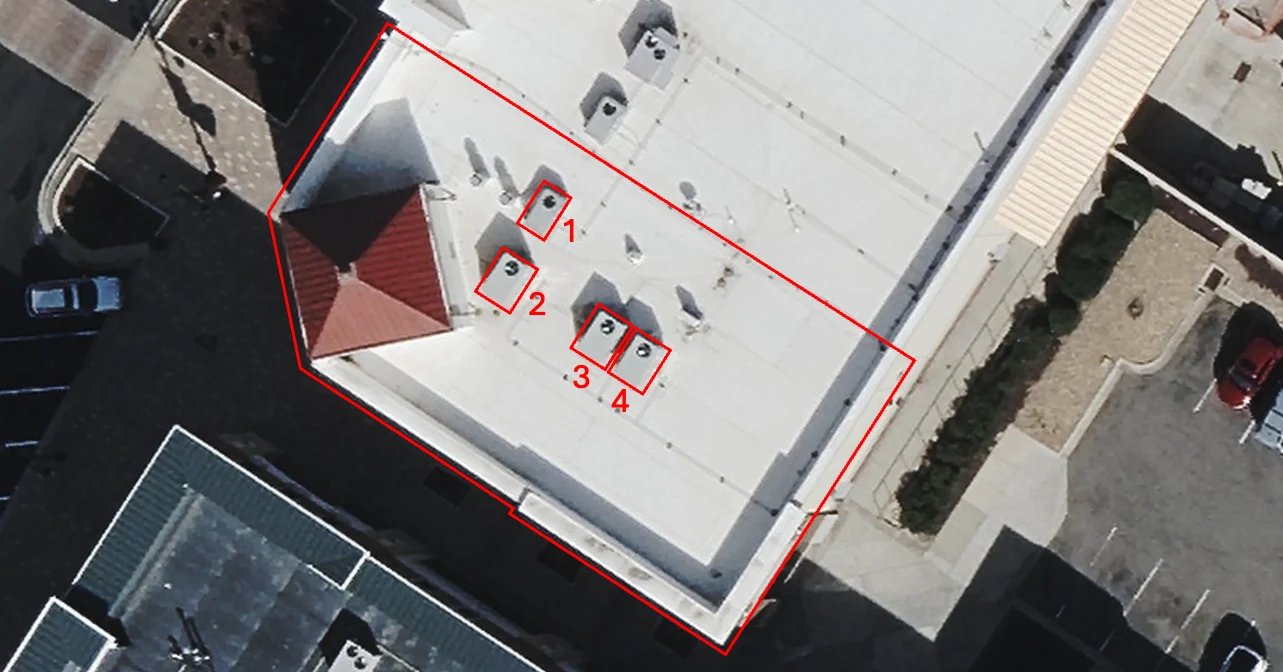
| # | Type | Mfr. | Model | Refrigerant | Tonnage | Age | Lifecycle | Parts risk |
|---|---|---|---|---|---|---|---|---|
| 1 | Packaged RTU |
Carrier | 48TCED08 | R-22 | 7.5 ton | 24 yr | 133% | High |
| 2 | Packaged RTU |
Carrier | 48TCED08 | R-410A | 7.5 ton | 15 yr | 83% | Medium |
| 3 | Packaged RTU |
Lennox | KGA060S4B | R-410A | 5.0 ton | 11 yr | 61% | Medium |
| 4 | Packaged RTU |
Lennox | KGA048S4B | R-454B | 4.0 ton | 6 yr | 33% | Low |
Your building is easy on equipment. Your lease is not.
Distribution and light industrial is the gentlest occupancy for rooftop HVAC: low internal load, no kitchen exhaust, no process heat, long stretches near-empty. How you use the building runs in your favor.
The lease does not. The landlord owns the equipment; you pay to keep it running. Whoever would fund a replacement never sees that cost, and whoever pays it cannot replace an asset they do not own. Expect these units to outlast the point where replacing them makes sense.
One unit is past life. One is nearly new.
Against an 18 year expected life, RTU-4 sits at 33%, RTU-3 at 61%, RTU-2 at 83% and RTU-1 at 133%. Past year ten, frequency and severity climb together and the constraint shifts from parts wearing out to parts getting scarce.
The same repair costs more every year. Yours sit at the expensive end.
Every input on a repair bill is rising, and contractor markup compounds supplier increases before they reach you. Three of your four units run on refrigerants being phased out, which is where parts are scarcest and quotes highest. A repair quoted today is the cheapest it will ever be.
Gulf heat runs long, and never lets up.
Your units carry cooling load nine months a year, peaking in August. Unlike a dry climate, humidity holds overnight temperatures up, so compressors run through the night instead of unloading. Salt-laden humid air accelerates corrosion on coils, cabinets and electricals.
Your repair spend, locked flat. One number for all four units.
Four units cannot average themselves out. One compressor is your whole year. We take that variance onto our book and hand you a fixed price. You keep your provider; we review and pay the invoices.